

The Canary Islands strengthen their winter leadership in a highly profitable German market

Last year, 2.8 million German visitors chose the Islands for their holidays, accounting for 15% of the total, while generating an even higher share of revenue, with €4.193 billion and 18% of the total.
German travelers are particularly valuable for the destination, as they are characterized by longer stays, high spending per trip, and strong loyalty to the archipelago. They spend an average of €1,641 per trip and have one of the longest average stays, at 11.1 days, well above the overall average of 9.3 days.
German travelers are characterized by longer stays, higher spending per trip, and strong loyalty to the Canary Islands.
This is the most evenly distributed source market across the Islands, although its importance is particularly notable in Fuerteventura and La Palma, as well as for the traditional accommodation sector in La Gomera.
These visitors also stand out for their high loyalty: 71% are repeat tourists, and 20% (around 567,000 Germans) have visited the Islands at least ten times. Furthermore, 16% show high recurrence, having traveled to the Canary Islands at least once a year over the past five years.
During the winter season, the archipelago remains their top destination, well ahead of the Balearic Islands, Egypt, and Turkey. This demonstrates that German tourists continue to prioritize and value the Islands despite the challenging economic situation in their country.
During the winter season, the Canary Islands remain the top destination for German tourists, well ahead of the Balearic Islands, Egypt, and Turkey.
The German economy is currently facing a particularly complex situation, marked by a loss of industrial competitiveness against China, the impact of international tariffs on its export sector, and unemployment exceeding three million people, the highest level in the past decade. In addition, more than 17,000 business bankruptcies were recorded in 2025, the automotive industry is undergoing a profound transition with declining sales and job cuts, and public debt has increased following a government investment plan exceeding €500 billion. In this context, German consumer confidence remains very weak, leading to tighter control over household budgets.
These circumstances have resulted in a 6% decrease in German tourists visiting the Canary Islands this winter. Despite this, the Islands remain the clear leader during this season, with 1.7 million German travelers, well ahead of Turkey, which ranks second with fewer than one million tourists and a decline of up to 17%.
Some progress has been made in reducing the seasonality of German tourism and in positioning the Canary Islands as a destination with a pleasant climate in summer as well.
By contrast, last summer saw an increase in German visitors to the archipelago, which may be linked to the search for destinations with milder temperatures. Some progress has been made in reducing seasonality in the German market and positioning the Canary Islands as a destination with a pleasant climate even in summer, an attribute that has traditionally required greater communication efforts.
Premium and nature-focused tourists
Another characteristic of these travelers is that their holidays are mainly focused on exploring and discovering the Islands (30%). Their favorite activities include walking (57%), exploring the island independently (55%), and hiking (23%).
This is why our strategy in the German market focuses on attracting premium visitors, higher-value tourists for the destination. To this end, a specific campaign is already underway between November and March, with an investment of €512,000.
In addition, efforts continue to connect with German travelers motivated by nature tourism. The first campaign of the year will be linked to Earth Day and will prioritize the German market, targeting visitors with medium-to-high purchasing power and strong environmental awareness. This will be complemented by a dedicated birdwatching campaign, aimed at travelers who generate high spending and prioritize conservation and environmental knowledge.
Islas Canarias sigue conectando con el viajero germano con motivaciones vinculadas al turismo de naturaleza.
This approach builds on initiatives developed in 2025 in the German market, focused on promoting concepts such as “slow travel”, enjoying destinations at a relaxed pace, and a campaign highlighting the Canary tourism sector’s commitment to sustainability through audiovisual content.
7% lower carbon footprint
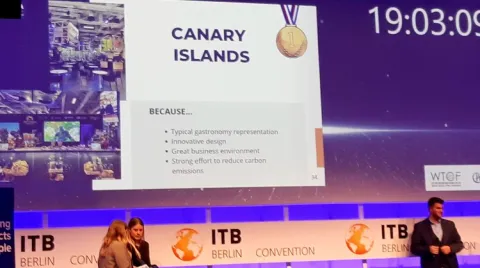
In terms of sustainability, the Canary Islands’ presence in Berlin has once again reduced its carbon emissions. Overall, the revised carbon footprint of ITB 2025 was 35.8 tonnes of CO₂e, which has been reduced this year by 7.3%, equivalent to 2.6 fewer tonnes of CO₂e.
When analyzing carbon footprint per square meter, the reduction is even greater, reaching 10.7%, equivalent to 4.9 kilograms less CO₂e emitted per unit of stand space.
Una de las principales novedades del estand de Islas Canarias en ITB es el refuerzo de la zona de trabajo de libre acceso para profesionales.
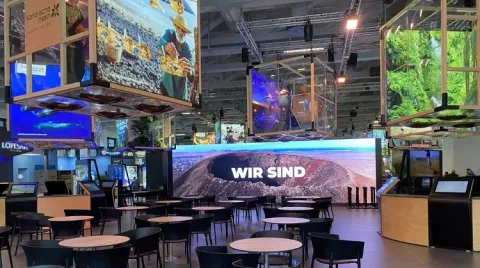
This year, the archipelago features an 804 m² stand, with one of its main innovations being an expanded open-access workspace for professionals, including 21 tables with capacity for 84 people, in addition to private booths for 18 companies.
The Canary Islands stand stands out for its avant-garde, immersive design, built around the concept “The best climate in the world.” It abstractly recreates the archipelago’s geography and the influence of trade winds through a striking 270 m² parametric structure made from sustainably sourced wood. Among its key features is a large central high-resolution videowall measuring 14 by 3.5 meters, displaying dynamic images of the Islands and data-driven atmospheric graphics, along with multiple LED screens and interactive devices distributed throughout the space.
The stand also includes a traditional juice bar offering typical Canary fruits and a tasting area for local products and wines, with a dedicated space featuring six tables and capacity for 24 people. Additionally, interactive 55-inch screens invite visitors to deepen their knowledge of the destination through a dynamic quiz about the Islands and an innovative challenge that involves distinguishing real images of the archipelago from those generated by artificial intelligence.
* Co-financed by the European Union (ERDF).