

Criteria agreed for selecting the five RegNext pilot projects with operators at ITB

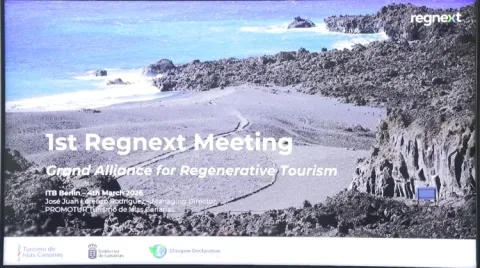
Within the framework of the German trade fair, a meeting of the Commission of the Alliance for the Regeneration and Renaturalisation of the Canary Islands was held, with the participation of international and Canary Islands-based operators such as TUI, easyJet, Skyscanner, Untours Foundation, DERTOUR, Lopesan, and Loro Parque, as well as Ashotel and representatives of the island councils. The Travel Foundation, a leading international organization in tackling climate change in the tourism sector and our strategic partner in the design of RegNext, also attended.
This first working session marks a decisive step following the formal establishment of the alliance at FITUR. A draft document is now in place outlining the criteria for selecting the five projects, which will have both environmental and social components. Public and private entities, NGOs, collectives, and associations will be able to submit their proposals. The initiative aims to achieve high levels of citizen participation, complementing the tourism sector, which has formed a coordinated public-private front to implement initiatives that will benefit the entire archipelago.
Projects within the RegNext program must demonstrate tangible impact, clear technical and economic feasibility, and measurable, visible results for Canary Islands society.
As agreed during the meeting, projects must deliver tangible impact, have clear technical and economic feasibility, and produce measurable and visible results for the local community. Environmental requirements will include the effective restoration of priority habitats and measurable improvements in biodiversity, as well as social criteria such as the creation of local green jobs, training, and capacity building.
The program design also incorporates a legal and administrative framework, including independent audits and clear, viable tax incentives for participating operators. Work is already underway to provide legal safeguards ensuring full traceability, from funding contributions to project execution, so that every euro reaches its intended destination, as contributions are voluntary and earmarked.
A digital platform will be launched to provide a simple and transparent experience for tourists, residents, and businesses, enabling them to track the progress of projects.
A digital platform will be launched to provide a simple and transparent experience for tourists, residents, and businesses, enabling them to track the progress of projects. Users will be able to see which initiatives are underway, companies will be able to monitor how their contributions are allocated, and clear information will be provided about which private entities are funding each project, ensuring responsible communication and marketing. The final phase, planned for 2027, will enable tourists themselves to contribute directly to these projects.
The Canary Islands anticipate Europe
Advancing the regeneration of the archipelago through a voluntary model with public governance and full traceability places the Canary Islands and the international and national operators involved in RegNext at the forefront of the European debate on how to finance territorial restoration. In fact, the EU Nature Restoration Regulation makes ecosystem restoration a legal obligation, requiring at least 20% of land and sea areas to be restored by 2030 and all ecosystems by 2050.
RegNext responds to the reality that public funding alone will not be sufficient to meet these goals. The initiative is based on the idea that, if tourism is the main economic driver of the archipelago, it can also become a structural driver of its regeneration.